

The South Korean market is a peculiar one and somewhat in vogue at the moment. Nobody seemed bothered about it a year ago, but with the sudden mania around SK Hynix and Samsung, coupled with the availability to now trade via IBKR, it’s become a hot market. Both amongst the glamour chasers and the deep value hunters.
Despite selling cutting edge 720p Samsung TV’s at Currys when I was a teenager (that stock also seems to be doing well lately), I know next to nothing about Samsung or SK Hynix. I’m also a tad nervous about the stocks at the lower end of the market, with legitimacy questions over some. Despite some of the dirt-cheap valuations I have been warned to be careful by peers who know the region.
This stock is still a microcap (around $125m USD), but it’s robust history and near 50% market share in a niche and high-barrier-to-entry market piqued my interest when I saw the numbers.
The Pitch
JW Life Science is South Korea’s dominant manufacturer of essential intravenous (IV) fluids and nutrition.
The market prices the business at decade-low multiples due to an acquisition overhang and recent hospital labour strikes. I see an entrenched manufacturing moat, essential national supply status, and international export opportunity.
This company is a double-digit grower, and at the current share price you can pick it up for ~6x earnings and a little over tangible book value.
Normalisation of surgical volumes across South Korean hospitals, coupled with cost reductions and steady export growth, will in my view close the valuation gap over the next few years.
The Business & Situation
The core operations are medical in nature but fairly straightforward. They produce sterile liquids in plastic bags at massive scale. When hospital patients undergo surgical procedures, sustain physical trauma, or experience internal failures, IV nutrition sustains life.
JW Life Science manufactures these fluid formulations inside an automated production plant and primarily operates via two routes:
The domestic business (94% of sales) generates a predictable, demographic-driven 5% to 6% growth
International expansion through partnership (Baxter), growing at a 20%+ CAGR as the high-margin booster
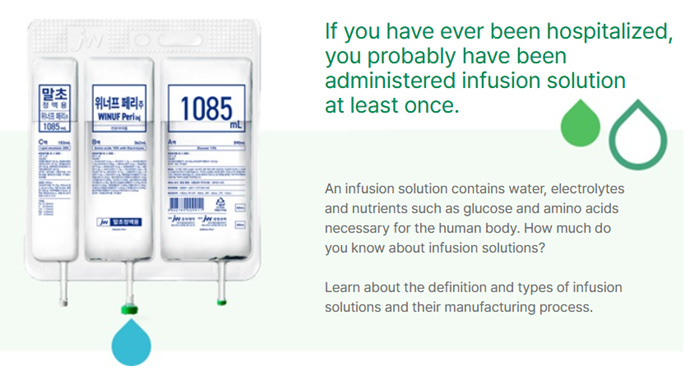
They broadly have 5 or 6 product lines, with their flagship product category “Total Parenteral Nutrition” at 36% of revenue, and basic infusions at 29%.
I won’t get technical, but key to know is that JW Life Science holds the No. 1 domestic market share across South Korea’s market
Total Parenteral Nutrition: 48.5% market share
Basic Infusions: 42.9% market share
A formidable position.
Their products are essential national medical supplies in South Korea. Due to a strict quality criteria, bulky transport requirements, low unit pricing, and capital-intensive infrastructure they operate with heavy natural barriers to entry, deterring foreign competition.
Domestic distribution occurs mostly through sister entity JW Pharmaceutical, which delivers to general hospitals and dialysis centres across the country. The end customers (and payer) are typically the national health service and some private patients/private insurance.
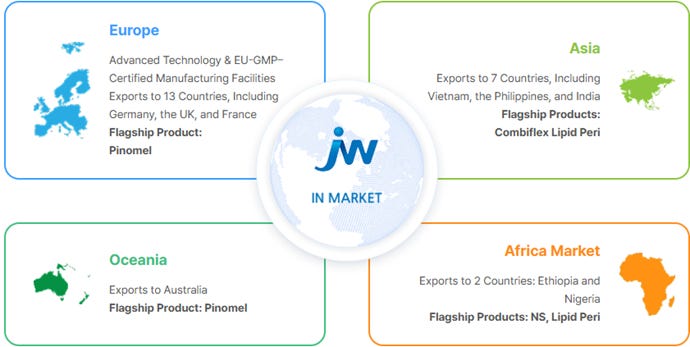
As mentioned above, internationally they partnered with global healthcare supplier Baxter, now distributing to more than 20 European countries and Asia-Pacific markets. Management guide that this export growth will account for roughly 20% to 25% of operating profit growth over the next three years.
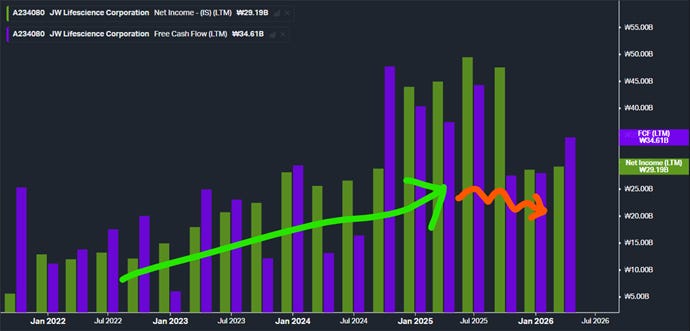
Crucially, as the net income and FCF chart below shows, this is a robust earnings compounder.
5-year revenue CAGR = 11%
5-year net income CAGR = 22%
So why the bargain valuation? I gather there are three primary reasons:
JW Bioscience - Between 2020 and 2024, the stock was suppressed by a complex four-year agreement surrounding subsidiary JW Bioscience. JW Life Science was used as the vehicle to absorb JW Bioscience (an unprofitable entity) from sister affiliate JW Medical. The short of it, it was essentially an acquisition for a cost of ~70B and around a third of market cap at the time. This multi-year overhang drained cash (the overhang mechanically ended in the 2025 numbers), with the capital reallocation raising investor concerns that cash generated would fund group ventures. Today, JW Bioscience has swung from losses into a self-funding business that is generating profit.
Medical Strikes - What Wikipedia labels as the “2024–2026 South Korean medical crisis” (2024–2026 South Korean medical crisis - Wikipedia). A multi-year labour strike involving doctors reduced hospital occupancy and delayed procedures (the “Big 5” university hospitals halved surgery schedules). In turn, this flattened domestic IV consumption. The standoff has now ended (Oct 2025) and schedules have 95% normalised. An actual silver lining came from this too, with JW expanding its domestic market share during the strike given their extensive nationwide network and ability to re-route products elsewhere. A problem smaller players struggled with.
Stagnant Dividend - Despite earnings compounding from 12.9B in 2021 to 28.6B in 2025, the dividend remained fixed at 500 per share. This optically stunk and I don’t think helped investor sentiment towards the stock / management. 2025 finally saw this change, the dividend was not only increased by 10%, but management have now committed to a “25% or more” income payout ratio, which should mechanically increase future dividends with earnings. The yield today is currently 4.8%, so fairly healthy.
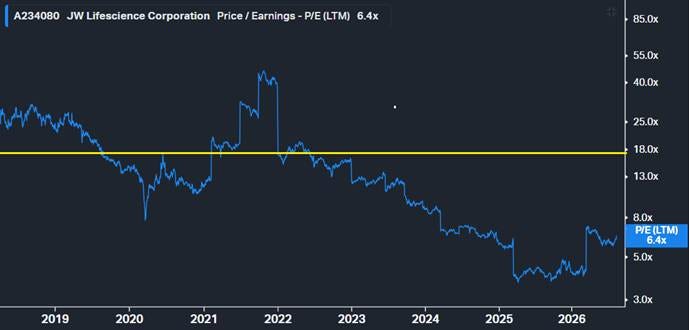
Ultimately, these reasons caused multiple compression (despite reasonable earnings growth), as you can see in the chart below, with the stock drifting down from a mid-teens multiple. With these issues now in the rearview mirror, and reasonable growth plans ahead, I see good reasons for the multiple to revert upwards.
The Asset Case (Downside Protection)
The consolidated balance sheet carries 77 billion in intangible assets, stemming from the historical absorption of JW Bioscience. Looking closely into the real tangibles we get the following:

Note: Table reflects full-year 2025 figures. Subsequent Q1 2026 filings show working capital cash generation that expanded bank deposits to 29.1B, reducing receivables and net financial debt to 12.9B, strengthening the tangible downside floor.
The “economic value” column above is my assessment. The accounting figures record the physical production facilities at depreciated historical cost so the real estate contains tangible value beyond statutory carrying figures, which I have calculated from a bit of research. You may think differently about the land and buildings, but I don’t think it materially moves the needle a great deal in terms of the margin of safety.
This isn’t as cash rich as other stocks I have wrote about, but what this lacks in liquid assets it makes up for in the robustness of its earnings power as a market dominant player in its niche.
Here we have a strong business with the physical balance sheet protecting against severe capital loss.
Catalysts & Re-rating Path
In a simple sentence I think this business just needs to get back on track with mid-single-digits topline growth and double-digit earnings growth. Important drivers are as follows:
High-margin product rollout & International scaling – Management remarks that growth will be driven by a mix shift from simple saline toward “high-value nutritional” bags, in conjunction with international scaling. Domestic sales of saline are subject to government price caps, with international expansion of higher-value products not subject to such constraints and fetching significantly more per unit. Whilst overall volumes of the latter product are notably less now (international is currently 6% of sales), scaling exports should lead to expanding margins and have an asymmetric impact on incremental operating profit. Especially given international sales are expected to growth 20%+ annually.
Margins are inflecting; Gross moving from 25.8% (2024) to 28% (2025). Recent Q1 2026 was 29.5%.
Turning the page on JW Bioscience - In the recent results this now makes up ~10% of profits. Assets now cover liabilities and the capital drain is over. Continued execution is needed.
Dividend growth & governance - Management formally committed to a 25%+ payout target and must do so. They’ve also amended the corporate charter to introduce quarterly dividends. Shareholder friendliness should be welcomed by investors.
Operating leverage - Having increased its domestic market share during recent hospital disruptions, the company should capture operating leverage as throughput normalises.
Energy Utility / Savings – Many JW processes are energy/utility intensive. They are introducing their own energy generation facilities which should lead to an estimated 2-3 billion in annual savings, equating to a structural 6% to 9% uplift in operating profit
Balance sheet deleveraging – Interest bearing debt has reduced from 67B (2022) to 40.3B today, with debt to equity sliding from ~48% to ~18%. Generating 25B+ annual FCF the business is on track to cross into a net-cash position soon.
Overall, there’s a good handful of tailwinds. Nothing heroic is required, just steady execution.
Risks & What Could Go Wrong
To an extent some of these are the inverse of the catalysts. Key things to watch out for include:
International expansion – If international growth fails to gain market share against entrenched European incumbents and export volumes plateau, an important growth engine may not be realised. Domestic sales are expected to grow at a stable 5-7%; it is the international opportunity where the high-margin high-growth kicker comes from.
Management value destruction – namely sinking money into acquisitions or capital injections elsewhere. Recent reporting looks favourable that this wont happen: “as of the disclosure date, there are no plans for large-scale facility investments or capital expenditures.”
Price ceilings - The Ministry of Health regulates rates via statutory reviews. If authorities reduce the price ceiling, whilst import prices (oils, plastics etc) push up, gross margins will narrow. I hope this risk would be partially cushioned by the increasing revenue contribution from premium bags expansion.
The thesis breaks if management makes a large-scale capital destructive move, or international expansion stalls notably.
Valuation & Expected Return
A reminder, as of today we’re around ~6x PE and ~1.2x TBV. Market cap 181b.
Downside Case (Stressed Realisable Value) - Hospital volumes remain depressed, global expansion stalls and we experience write-downs. I think the true economic value of the tangible assets (as shown by the table above) is at least 160b. Even haircutting this a bit more (130/140B TBV) and the downside from today’s market cap is ~25%
Base Case - Domestic hospital volumes normalise and operating margins revert upwards a little. International does “ok” but not great. The market credits this a few years out at around 9x normalised earnings of around 34B – not at all ambitious for a firm growing a steady ~6%
310b market cap two years out = 71% upside
Add a few years of 4.8% dividends exceed 80%
Bull Case - International exports do well, all margin accretive initiatives execute and the market prices the stock at a PE of 12 on a net income of around 38b. Again, still a conservative multiple if we are seeing double-digit profit growth.
456b market cap = ~260%+ including dividends
The recent results show this could be a little bumpy in the very near-term but the fundamentals looks good. Even if this business plods along at GDP-like growth from here, it’s very likely worth more than 6x earnings.
I think there’s a limited downside risk given the tangible assets, with a fairly believable path to a 2x or 3x.
I see good reasons for why this stock can trade at a mid-teen multiple (as it has in the past), if it executes and evidences robust high-single/low double-digit growth.
Disclaimer:
These write-ups aren’t month-long research reports and could omit material information, so I always welcome feedback. As always, please do your own research.
The companies discussed often involve complexity or risk, and outcomes can vary widely. Investing in small/micro-cap stocks carries a higher risk of capital loss.
The author may hold a long position at the time of writing. The author may buy or sell shares in this company at any time without further notice. This post is for informational and educational purposes only and does not constitute financial advice.
Great write-up! I have one question, though: do you think the price paid for the Bioscience acquisition was not capital-destructive? I’m asking because I am concerned about the corporate governance and the possibility that, shortly after deleveraging, they could pursue another acquisition.
Hi Bruce, so these companies do not have annual reports in English?