
A 130m Claim on 362m
Trading at a third of Book with Insider Buying.

Some people have cool hobbies like mountaineering, building AI assistants, or… Warhammer?
I have this weird one where I go looking for stocks at 20-year lows relative to their book multiples.
Sometimes I find them, sometimes they just find me. A big thank you to the subscriber who put this one on my radar a short while back.
The Pitch
EXEL Industries makes the machines that spray crops, paint cars, and water gardens. It has century-old brands that no one will have ever heard of outside of the relevant sectors but are regarded as stellar.
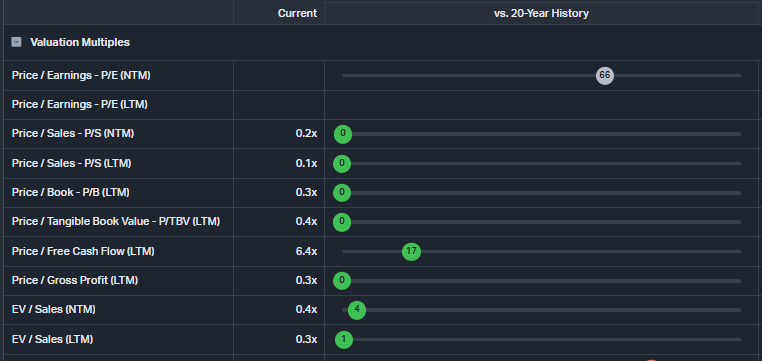
The business is currently in a cyclical downturn, with the global agricultural machinery sector and European auto sector in a trough. The market prices this like a zero - at its lowest multiples in over two decades across nearly all valuation measures.
Shares trade around 0.36x TBV - but are backed by real assets.
For this to re-rate, the agricultural equipment cycle needs to turn, something management itself flags as plausible next year.
Of course you can wait until then, but the bargain price is now. Maybe management agrees, given the recent dabble of insider buying too.
EXEL has spent most of the last 20 years trading notably above book value. I see no strong reason this cycle will be any different.
The Business & Situation
EXEL is quite simple. It sells specialised machinery that applies liquids precisely. Through three verticals you could summarise in an over-simplified manner as pesticide onto crops, paint onto car bodies and water onto gardens.
They supplement this with selling spare parts and servicing to keep the equipment running for decades.
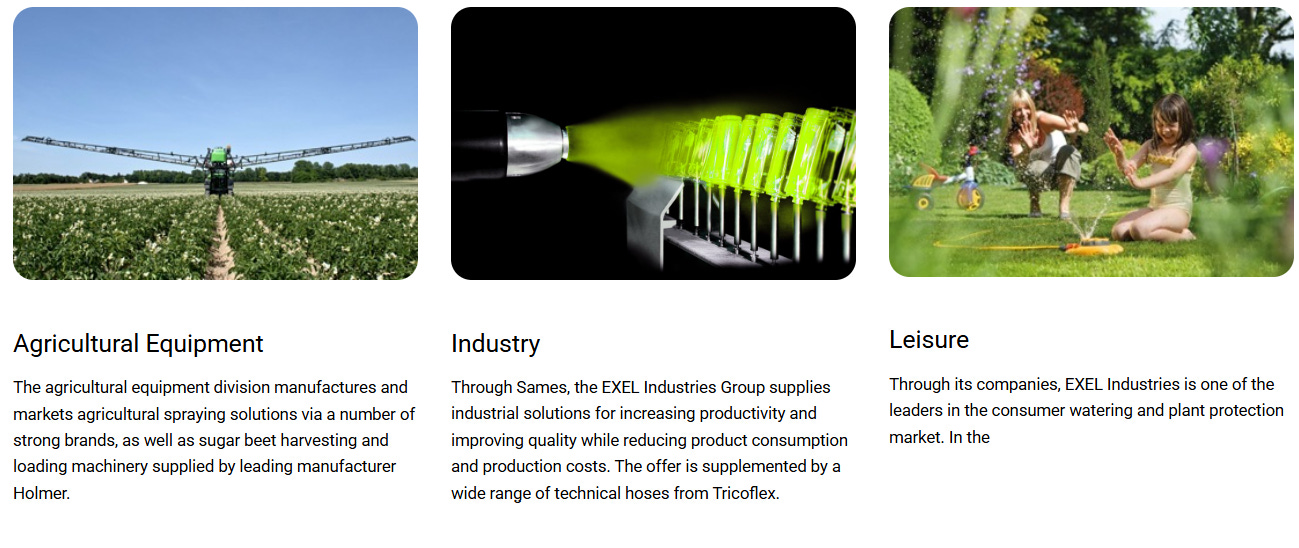
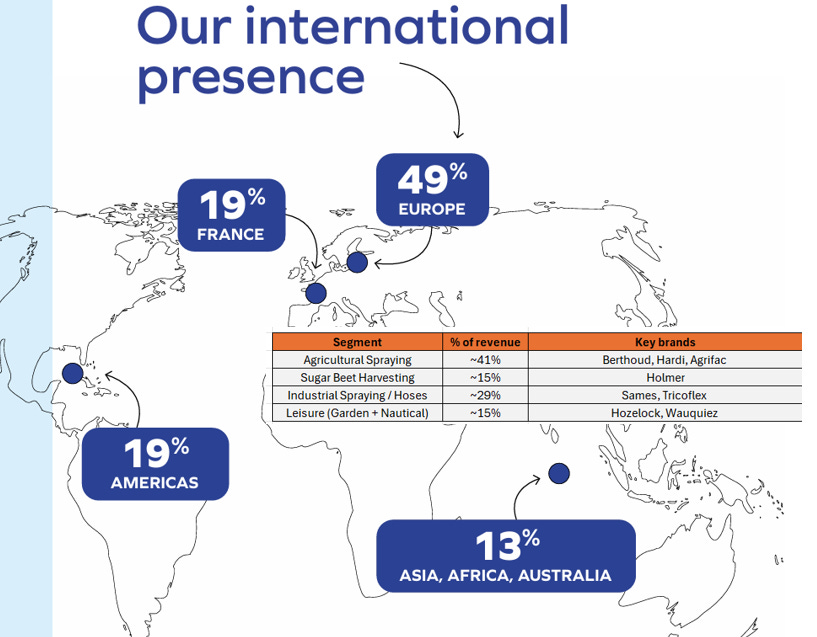
The customer base is diverse. Farmers, large OEM customers like Stellantis, professional dealers/importers, gardening hobbyists through DIY stores, and wealthy individuals commissioning yachts. Via either route, EXEL’s brands offer engineering credibility, a breadth of range (including various price points), and after sales support.
At its core, EXEL sells precision. Its customers need the ability to be very accurate with their liquid use cases. A farmer overspraying pesticide wastes money and might break environmental rules. A car manufacturer overspraying paint uses too much expensive material, and so on.
It seems to be in the bargain bin for cyclical reasons, not structural.
Revenue peaked at 1.1b in 2024, fell to 983M in 2025, and has since continued downward, shaving another 15.9% as of Q3 2026. Clearly not good at first glance, but not untypical in a sectorwide dip. The broad causes are split into themes:
Interest rates and financing - the recent H1 release states “high interest rates and declining agricultural income, leading farmers to postpone investments”
Weak crop prices - Again direct from management: “European and North American farmers continued to postpone investments, as a result of lower agricultural prices, higher input costs and tighter financing conditions”.
Industrial spraying hit by weakness in European automotive
I did some digging on the agricultural markets to ensure there’s strong evidence this is an industry-wide issue and not a specific problem to EXEL.
S&P Global Market Intelligence tracked revenues across the world’s leading farm machinery makers, with sharp double-digit drops in 2024 and 2025. See chart below.
VDMA (German Agricultural Machinery Association) reported a 28% decline in German agricultural machinery and tractor sales in 2024, describing the downturn as “unusually uniform in all markets worldwide”
Axema (French agricultural equipment industry association) reported the French agricultural equipment market fell 9% in 2025 (tractors down 18.5% and harvesters down 25%)
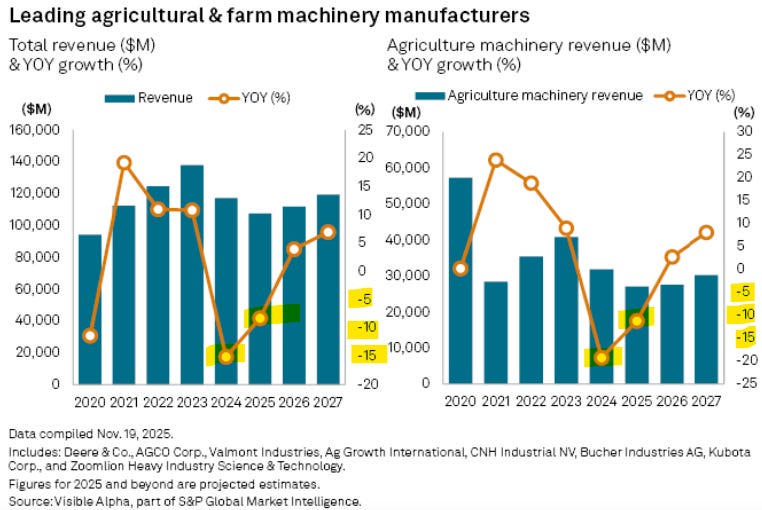
So my take is that this a textbook demand-deferral cycle as opposed to a competitive or technological obsolescence problem specific to EXEL. Registration data across all of Europe and North America shows the same thing, a story of a multi-country capex freeze.
Slightly encouragingly, management have repeatedly noted that spare/used parts, components, and after-sales have performed better (or held up) and has partially cushioned new-machine declines.
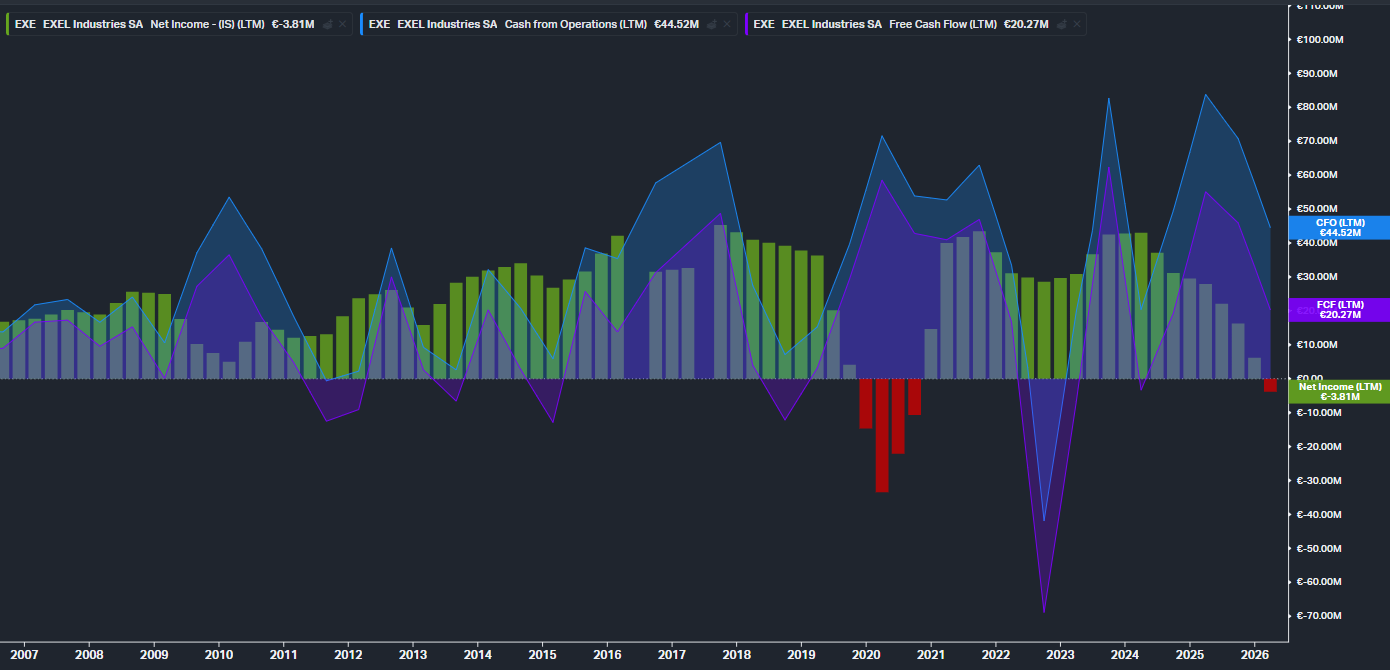
However, there’s no denying short term weakness given the group posted an 18.6m net loss in H1, its first loss in years. As a result, the share price has reacted violently, down roughly 51% over the last year.
The question remains whether one has faith in the cycle turning - hopefully in 2027, indicated by the S&P chart above and EXEL management’s own outlook.
The Asset Case (Downside Protection)
This is where the appeal comes from. EXEL has total assets of 926m against total liabilities of 479m, leaving equity of ~446m.
Today the market cap is 129.5m
Strip out goodwill and other intangibles and TBV sits at roughly 362m. An incredible 0.36x TBV.
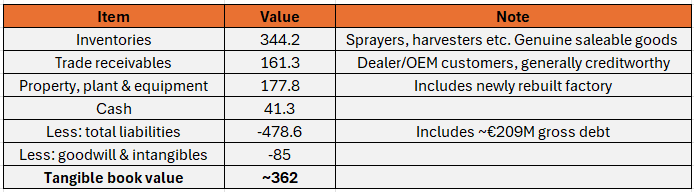
The market is offering you the ability to pay 36 cents for every euro of hard working assets.
Putting a conservative hat on, adjustments may be required. Inventory the obvious choice given equipment can be slow-moving in a downturn.
Regarding PP&E, it’s likely its value is actually understated in the books. EXEL has 24 production sites, some dating back generations, so it’s plausible that land and older buildings are stated below what they’d cost to replace or what they’d sell for.
Running a stress-test with a 30% inventory haircut and 10% receivables haircut, and a 20% haircut on PP&E still leaves adjusted tangible equity around 200m. Still absolutely miles away from today’s 130m mcap.
This stock isn’t far from being a net-net, with ~114m NCAV (NCAV ratio 1.14x)
A very big margin of safety: you’re paying less than (arguably distressed) break-up value for a business that on any normalised earnings basis is worth considerably more.
This is a strong asset-backed situation where the downside is cushioned by real factories, brands, and inventory.
Catalysts & Re-rating Path
The clearest catalyst is simply the cycle normalising. Management already flagged early stabilisation in some regions, particularly Australia and North America (32% of sales) have returned to growth. Europe does remain weak, so I can’t sit here with utmost confidence that the bottom is in.
Third party data is mixed and doesn’t cleanly support a bottoming narrative yet. Some forecasts such as BNP Paribas point to a German-led recovery taking hold later in 2026 on the back of increased defense and infrastructure spending.
A slightly encouraging snippet from the CEO in the latest quarterly update:
“we observed some encouraging developments in certain business segments compared to the beginning of the fiscal year “
Q4 earnings (October) and full-year results (December) are key to see whether the deceleration is stabilising/bottoming.
There are also some product and operational investments ongoing, including new machines, digital tools, plant reconstructions and a new ERP suite. I don’t want to overegg these and they are not near-term catalysts by themselves, but they evidence that the company is investing through the trough.
On the other side of the margin equation, cost actions seem to be underway. Management is not passive and have discussed short-term cost-cutting measures in weaker entities.
I am also more positive than negative on the heavily aligned family ownership. Brands don’t last 100 years without a multi-decade horizon, reducing the risk of value-destructive short-term decisions and increasing the odds that management waits out the cycle with discipline.
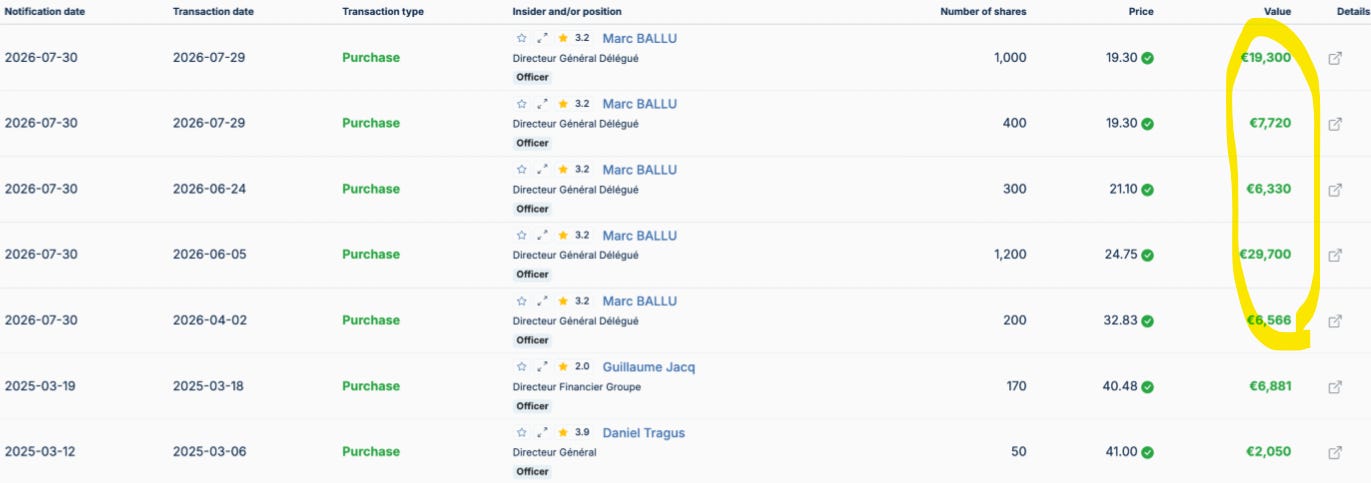
And on that note: Insider buying. There’s been a reasonable amount from the CEO recently, around 70k.
Risks & What Could Go Wrong
The single biggest risk is that this cycle is longer or deeper than management expects.
In that situation a big issue is that the sizeable inventory takes longer to convert into cash. With that comes potentially forced discounting, higher provisions and increased pressures on margins; eroding the tangible book value.
EXEL’s debt profile is highly seasonal. Debt typically peaks around March (as inventory builds ahead of the spring selling season) and strengthens back by each Sept year end as that inventory is sold down (Net debt has improved YoY). The risk to watch is whether the Sept 2026 year-end low-point is meaningfully worse than seen in 2025, which hints the downturn is starting to structurally erode the balance sheet.
Of note, the H1 release states that EXEL renewed credit lines successfully and retained financing capacity. That materially reduces any near-term “balance-sheet crisis”
Valuation & Expected Return
Starting with the below graphics, you can see this stock is trading at 20-year lows across many multiples. Over these 20 years, EXEL has compounded book value at 6.1% a year.
Not a sexy business, but a solid industrial.
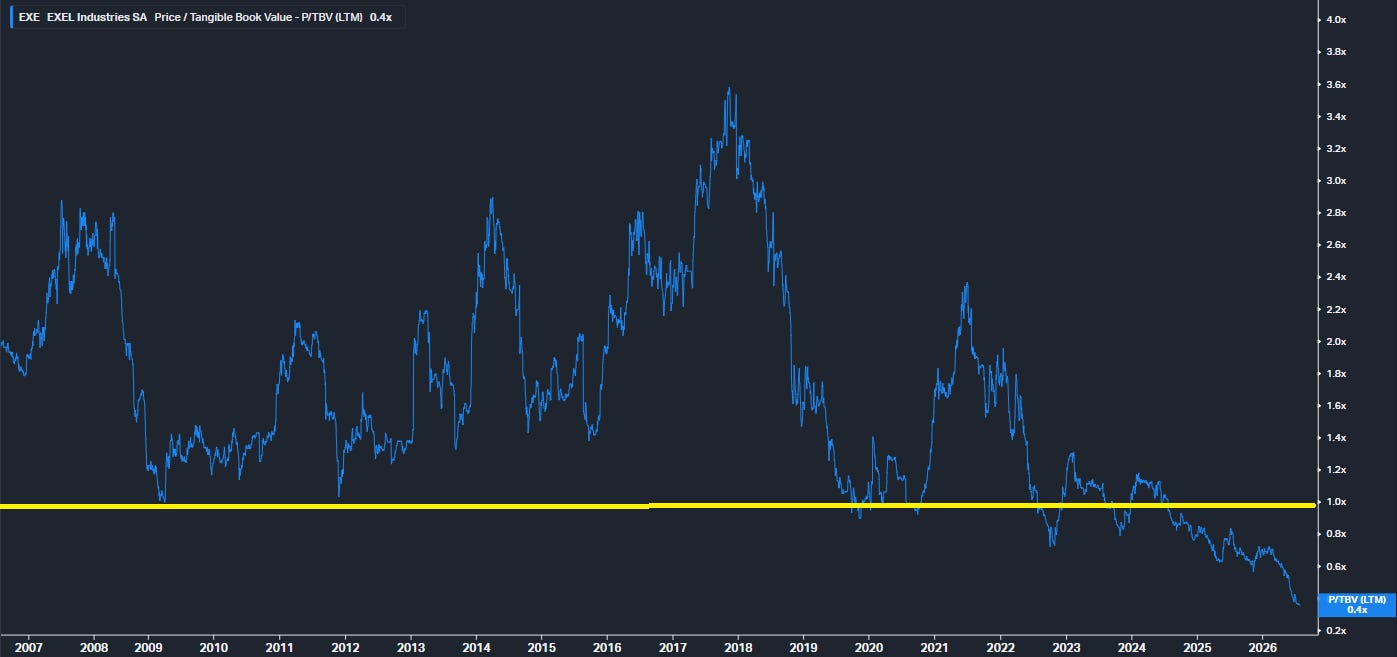
Base case: A re-rating back to just 0.9x TBV (below the yellow line, still well below long term norm and still a discount to peers trading ~1.5x) over a few years as the cycle turns. Implies market cap of ~320m and a 2.5x upside
Downside case: Stressed/liquidation style with 30% inventory haircut, 20% on receivables and PP&E puts value around 200m. Of course this stock can get cheaper, but being priced today at ~130m today is a big buffer.
Upside case: A full cycle recovery back toward normalised profitability:
~45m net income (comparable to 2021 and 2023) at 10x multiple = ~450m
Around 1.4x TBV = ~500m
Midpoint of the two = 475m and over a 3.5x return
A few years back this company had a peak market cap of around 800m. Today it’s 130m. Of course that’s not a scientific way to value a stock, but a form of cycle normalisation could get us someway there.
EXEL is not a conventional net-net and it is not yet showing a clean operational bottom. It trades at roughly 0.36x tangible book and around 1.14x NCAV, while its inventory balance and seasonal debt build are the central risks to monitor.
The investment case therefore rests less on a near-term earnings rebound than on the group’s ability to convert working capital, preserve tangible equity and survive until a meaningful recovery; hopefully in 2027.
The tangible asset base provides a credible floor notably below today’s stock price if the recovery is delayed.
Disclaimer:
These write-ups aren’t month-long research reports and could omit material information, so I always welcome feedback. As always, please do your own research.
The companies discussed often involve complexity or risk, and outcomes can vary widely. Investing in small/micro-cap stocks carries a high risk of capital loss.
The author may hold a long position at the time of writing. The author may buy or sell shares in this company at any time without further notice. This post is for informational and educational purposes only and does not constitute financial advice.